The Dolphins System Specs Games to be released Links to Other Dolphin Sites Our Sponsors
Project Dolphin

The most powerful of the next generation game consoles is Nintendo's project code-named Dolphin. Although Nintendo
and its third-party publishers have yet to drop any official game announcements, Nintendo's Shigeru Miyamoto and other big guns have revealed that they are deeply involved with Dolphin projects. The completion of these games will likely determine the actual Dolphin launch date.

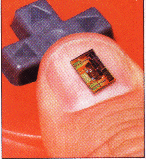
The games may not be ready, but most of the hardware is ready to rock. The Gekko Central Processing Unit chip shown here may seem tiny, but the Dolphin's 400 MHz CPU is the most powerful game console CPU in history. Gekko uses Big Blue's 0.18 micron copper technology, which gives it the speed to blaze by the competition. As the launch date for Project Dolphin draws near, Nintendo Power Source will deliver the official news first.

Gekko CPU

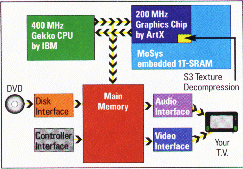
At the heart of the Dolphin is the Gekko CPU. Clocking in at 400 MHz, the Gekko avoids over-heating thanks to the heat dissipation properties of IBM's 0.18 micron copper technology.IBM is the only company with the facilities to manufacture these cutting-edge chips in mass-marketnumbers, which will help to keep Dolphin's price tag reasonable.

ArtX CGP

The Custom Graphics Processor from ArtX, Inc., in Palo Alto, California, was designed by a team led by Dr. Wei Yen — the chief designer of the N64 graphics chip. Our sources tell us that the ArtX graphics chip can produce many millions of textured polygons per second, much more than the closest console competitor. In this critical area of graphics, Dolphin will leave the competition in its wake.

Matsushita DVD

Dolphin features a DVD drive produced by Matsushita, more well-known under the Panasonic brand name. DVD discs store an enormous amount of data, many times the capacity of a CD-ROM. This is critical for storing video, audio and detailed 3D graphics.

S3 Compression

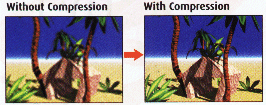
S3 texture compression technology from S3 Incorporated is embedded directly onto the ArtX graphics chip. The six-to-one compression ratio will result in saved game memory, but far more important is the fact that the decompression of textures is handled automatically by the graphics chip. The results will include elimination of bluriness, blockiness and monotonous repetition of the same elements on the screen. All of this will help push Dolphin closer to the frontier of real-time, ultra realistic graphics than any other game console.

MoSys

MoSys' patented 1T-SRAM technology is used in Dolphin to embed large, very high performance memory directly onto the ArtX graphics chip. It eliminates the transmission times between memory and chip. Gamers can expect more detailed graphics moving at higher framerates.